
OpenSCAD, reimagined for speed.
The OpenSCAD language you already write, running on a native Rust geometry engine. A model that takes 19 seconds in OpenSCAD finishes in 53 ms.
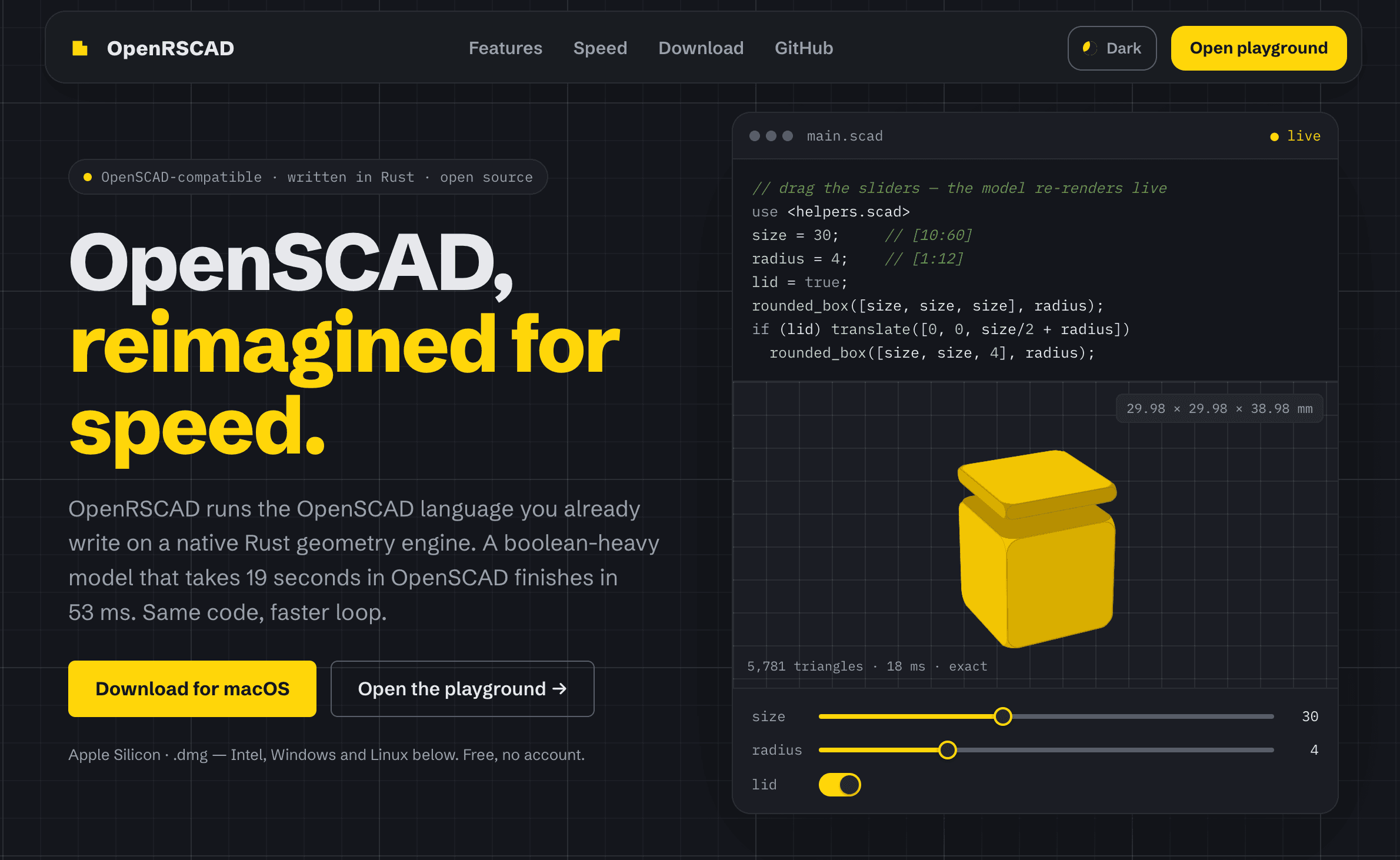
Same code, faster loop.
OpenSCAD is the CAD tool of choice for people who would rather write code than drag handles, and its language is beloved. Its default CGAL engine is not. Boolean-heavy models can take tens of seconds to render, which turns a tight design loop into a wait-and-see loop and makes real-time customization impossible.
OpenRSCAD runs unmodified .scad files on a native Rust geometry engine built on the Manifold CSG kernel. The same engine ships as a desktop app and, compiled to WebAssembly, as an installable browser playground. Nothing to port and no account to create. Models that stall OpenSCAD resolve while you're still looking.
A Rust core, booleans in milliseconds.
The engine is written in Rust on top of the Manifold CSG kernel, so the boolean operations that dominate real-world models run in milliseconds instead of seconds. The desktop app runs the native engine directly; the browser playground runs the very same engine compiled to WebAssembly, with no install and full offline support.
Compatibility was non-negotiable. Modules, use and include, customizer annotations, and the built-in functions people rely on all work as written, so an existing .scad file opens and just renders. The benchmarks are reproducible from the repo: same models, same machine, best of three runs, full-process wall clock.
Editor and preview, in conversation.
Hover any piece of geometry and the statement that produced it lights up in the editor. Click a face to land on the line that made it. Isolate any part to check it alone, then jump back. No more counting braces to find the cube you meant.
The customizer turns comments into controls: a range comment becomes a slider, a list becomes a dropdown, a boolean becomes a switch. Tweak values live, save parameter sets, and share a link that opens on exactly the model you're looking at.
// drag the sliders, the model re-renders liveuse <helpers.scad>size = 30; // [10:60]radius = 4; // [1:12]lid = true;rounded_box([size, size, size], radius);if (lid) translate([0, 0, size/2 + radius]) rounded_box([size, size, 4], radius);
Watertight output for any slicer.
OpenRSCAD exports STL, 3MF with color, OBJ, OFF, and AMF for 3D printing, plus DXF and SVG for laser cutters and CNC. PNGs and full animation frames capture straight from the viewport.
Because the Manifold kernel keeps every mesh manifold, exports are watertight by construction and slice without repair passes. The parametric workflow closes the loop: the moment a print reveals a fit problem, regenerate the part at a new size and export again.
Open a tab, or install it.
The browser playground is the zero-friction front door: it loads instantly, installs as an offline app, and shares models by link. The desktop build adds the native engine at full speed, local file open and save, and automatic updates. Both are free, open source, and account-free.
The positioning is deliberately additive rather than adversarial. OpenRSCAD isn't a new language to learn; it's a faster engine for the one people already know. That keeps the switching cost near zero and lets the benchmarks do the persuading.
Let’s build something big.
Tell us about your engineering goals. We’ll tell you how we’d get there.
Get in touch